
Skip to content

Davis & Salt Lake County

CMB HVAC — Utah's Local HVAC

AC Repair

Straightforward Air Conditioner Repair

Warm air, weak airflow, short cycling, ice, water, or a system that will not start can have several causes. CMB HVAC diagnoses the system, explains what failed, and gives written repair options before work begins.

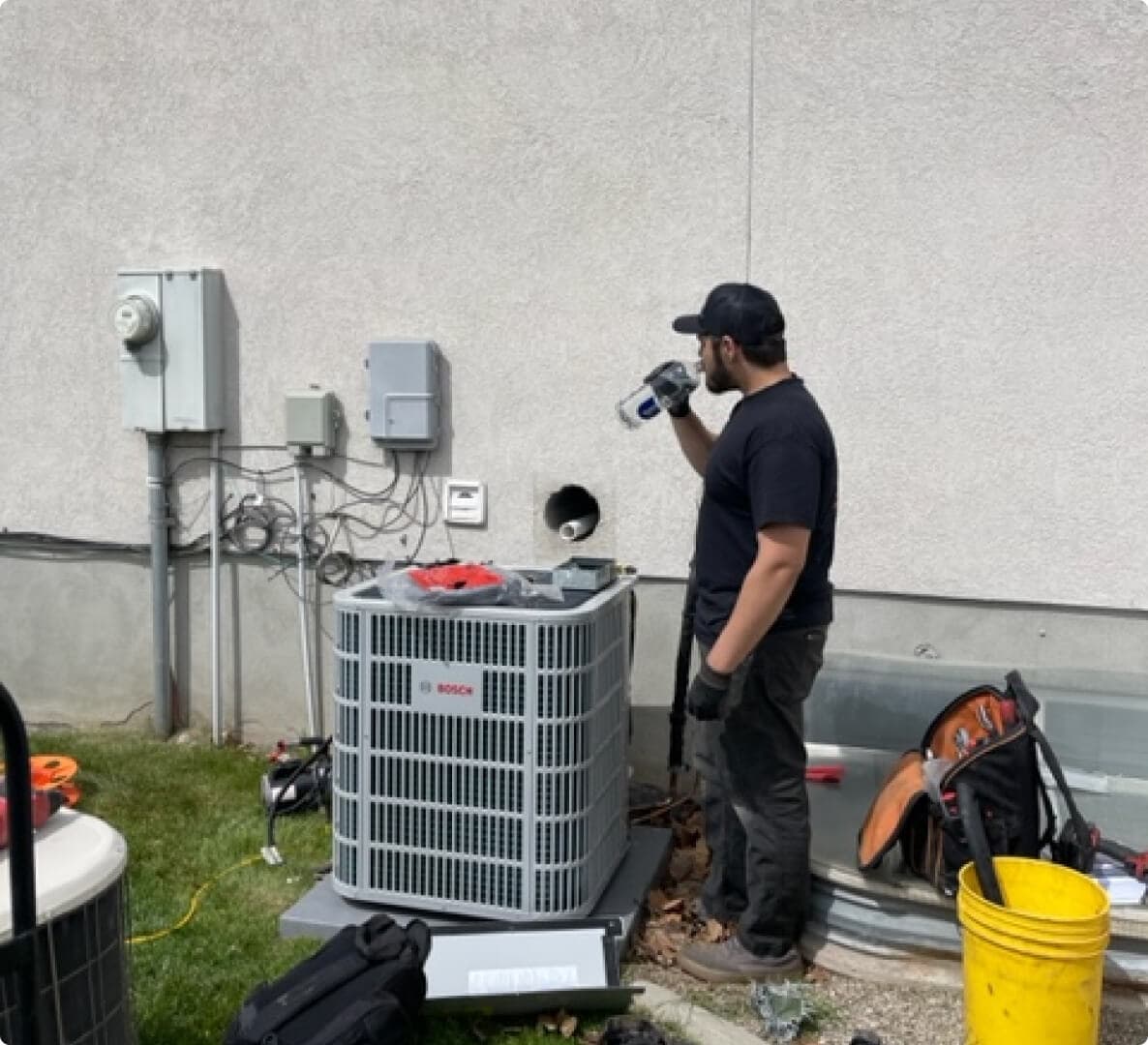
CMB HVAC technician repairing an outdoor air conditioner
5.0 ★
369 Google Reviews
Free
Service Call
Upfront
Fixed Pricing
Licensed
UT 12883822-5501

Straightforward Air Conditioner Repair

An air conditioner that isn't cooling is a symptom, not a diagnosis. The same no-cool call can end at a weak capacitor, a failed fan motor, a low refrigerant circuit with a leak, or a drain switch that shut the system down to protect your ceiling — so we test the thermostat and controls, electrical components, motors, airflow, coils, condensate, and refrigerant circuit until we know which one it is.

Then you get the finding in plain English with flat-rate options in writing before any work starts. After the repair we re-test temperatures, amps, and pressures so you know the fix held, and the service call is free when we do the work.

Diagnosed, Quoted, Fixed, Verified

No per-hour guessing on your dime. The diagnosis tells us the part; the flat rate is the price whether the repair takes forty minutes or two hours.

  • Free service call

    The diagnostic visit costs nothing when we perform the repair — and it's free even if the answer is replacement.

  • Flat-rate options

    Pricing is quoted per job, in writing, before tools come out — not per hour with an open ending.

  • Refrigerant-handling certified

    Our technicians hold EPA Section 608 certification for legal refrigerant work on every sealed-system repair.

  • Real cases, real numbers

    Every repair ends with re-tested temperatures and amp draws — verified on the meter, not assumed at the door.

When to Call for AC Repair

Tap a symptom to jump to the component most often behind it — then let the diagnosis confirm it.

What's Included in an AC Repair Call

  • Full-system diagnosis — thermostat and controls through the refrigerant circuit
  • The failed part explained in plain English, with the why, not just the what
  • Flat-rate repair options in writing before any work begins
  • Repair-versus-replace advice when the numbers are close enough to warrant both
  • Post-repair verification — supply temperatures, amp draws, and pressures re-checked
  • Free service call on every diagnostic visit

How We Diagnose a No-Cool Call

Symptoms overlap, so the meter decides. This is the sequence we work through on every repair call.

  1. Thermostat & controls

    We confirm the call for cooling actually arrives — wiring, settings, and control board — before blaming the big parts.

  2. Electrical components

    Capacitors and contactors are tested under load. Weak starting components cause most of the clicking-and-nothing calls.

  3. Airflow & filters

    A clogged filter or blocked return starves the system and mimics expensive failures. Cheap things get checked first.

  4. Coils & condensate

    Dirty coils strangle heat transfer, and a tripped float switch shuts cooling off to protect your home. Both are common.

  5. Refrigerant circuit

    Pressures and temperature split tell us if the sealed system is doing its job — and whether a leak search is warranted.

Hearing or seeing something that doesn't match this list? Call (385) 865-6749 — describe it and we'll tell you what it usually means.

Repair, Stabilize, or Replace

When a repair estimate is significant, you deserve the comparison side by side — both figures in writing on the same visit.

  • Repair the failed part

    The right call when the system is otherwise healthy: strong airflow, clean coils, sound refrigerant circuit, and a part that failed on its own schedule.

    Best for: systems under ~10 years with a single failed component

  • Repair now, plan the replacement

    Sometimes the honest answer is both — fix what gets you through the season, and get a replacement quote you can schedule on your terms instead of during the next heat wave.

    Best for: older systems with repairable faults and rising repair frequency

  • Replace the system

    When the failed part is a compressor or a leaking coil, the repair can approach a meaningful share of a new system. We'll show you both numbers and what each includes.

    Best for: compressor, coil, or multi-failure situations on older equipment

Technician holding a failed capacitor.
A failed dual-run capacitor — the most common no-cool part we replace, and one of the cheapest repairs when it's caught before it takes the compressor with it.

What Drives the Cost of an AC Repair

Two identical-looking no-cool calls can land at very different prices because the failed parts differ. Here's what actually moves the number.

Your flat-rate quote already accounts for all of this — the list is here so the quote makes sense, not so you can predict it yourself.

  • Which part failed

    A capacitor and a compressor are both electrical failures; their part costs are not in the same universe. The diagnosis determines the tier.

  • Refrigerant type

    Older systems running phased-out refrigerant cost more to recharge — one more factor in the repair-versus-replace math.

  • Access & complexity

    A part on an open condenser is a ten-minute swap; the same part behind a coil plenum or on a rooftop unit is a bigger job.

  • Season & availability

    We hold our pricing flat year-round — but scheduling in May beats scheduling during the first 100° week for appointment choice.

We quote every repair as a flat rate before work starts, and we don't publish price lists because two systems rarely fail the same way. Your written options are itemized — parts, labor, and any alternatives — so you can compare them line by line before deciding.

How a CMB Repair Runs Start to Finish

  1. Diagnose

    Free service call. We test the full sequence — controls, electrical, airflow, coils, drain, refrigerant — and find the actual fault.

  2. Quote in writing

    Flat-rate options, including the repair-versus-replace comparison when it's relevant. Work starts only when you say so.

  3. Repair

    The failed component is replaced or repaired with the system protected — drop cloths down, old parts hauled off unless you want to see them.

  4. Test & document

    Temperatures, amperage, and pressures are re-measured and recorded. You get the numbers with the invoice, not a handshake.

What Utah Summers Do to Air Conditioners

Utah's heat is dry, which is easier on people and harder on equipment in one specific way: long, high-load afternoons with big temperature swings overnight. Condensers run hard from early afternoon through evening for weeks at a time in July and August, and anything marginal — a weak capacitor, a dirty coil, a low charge — tends to fail during the first real heat, not during a mild spring test.

  • Cottonwood seed and fine dust pack outdoor coils every June — the single most common preventable fault we find
  • Nighttime cooldowns let homes recover if a system is slightly undersized; when a unit can't catch up by midnight, it's telling you something
  • Hard water and dry air mean condensate drains here mostly fail from debris and scale, not from heavy humidity loads

The Parts That Fail, and What Failure Looks Like

Component-level answers for the terms you'll see on your invoice — and the anchor points for the symptoms above.

Capacitor

The kick-start battery for the compressor and fan motors. When it weakens, you hear humming or clicking with no startup, or the fan spins only after a push-start. It's the most common no-cool part we replace, it fails faster in sustained heat, and replacing it early protects the far more expensive motors it starts.

Contactor

The relay that actually sends power to the condenser when the thermostat calls for cooling. Pitted contacts cause short cycling, chattering, or a system that ignores the thermostat entirely. Contactor wear is normal over years of use and is a straightforward flat-rate replacement.

Blower Motor

Moves air through the coil and into your ducts. A failing blower shows up as weak airflow from registers, a furnace fan that runs constantly, or overheating that trips limits. We test the motor and its control module separately — modern variable motors fail in their modules as often as in the windings.

Condenser Fan Motor

The fan in the outdoor unit that dumps indoor heat into the air. When it stops, the compressor runs hot and the system trips on high pressure — you'll hear the unit running with no fan turning. Shut the system off and call; running it in this state is how fan-motor failures turn into compressor failures.

Compressor

The heart of the refrigerant circuit and the most expensive single component in the system. Hard starting, tripping breakers, or cooling that fades as the afternoon heats up all point at it — but so can the cheaper parts above, which is exactly why a meter diagnosis matters before assuming the worst.

Evaporator Coil

The indoor coil that pulls heat and moisture from your air. Restricted airflow or low charge freezes it into a block of ice, and ice today is water damage tomorrow when it melts. Ice on the coil or the refrigerant line at the furnace means: turn the system off, let it thaw, and call us — don't run it frozen.

Condenser (Outdoor Unit)

The whole outdoor cabinet — coil, fan, compressor. It needs airflow on all sides, so landscaping rock, fences, and cottonwood fuzz are its natural enemies. Gentle hose-rinsing of the coil each season helps; pressure washers and chemical coil cleaners generally don't, and bent fins restrict the airflow the system lives on.

Thermostat

The only part of the system you actually touch. Dead batteries, a schedule nobody remembers setting, or a wiring fault can masquerade as a broken air conditioner. We verify the call for cooling at the thermostat before anything else — a surprising share of repair calls end at this step.

Condensate Drain

The coil wrings water out of your air even in a dry climate, and that water exits through a drain line that can clog with sludge and scale. When it does, a float switch shuts cooling off to protect the furnace and floor — so a no-cool call in August is sometimes a drain call. Flushing the line and treating it is routine maintenance.

Refrigerant Leak

Low refrigerant almost always means a leak, not a leak-free system that 'used up' its charge — refrigerant isn't a consumable. We find leaks with pressure testing and electronic detection, then quote the repair honestly: some leaks are at accessible braze joints, and some are inside a coil, where replacement is the sensible fix. Topping off without repairing the leak is money spent twice.

Straight Answers Before You Book

Why is my AC running but not cooling?
The usual suspects are a low refrigerant circuit from a leak, a dirty evaporator coil or filter strangling heat transfer, a failed starting component leaving part of the system unpowered, or a compressor that's running but not pumping. They all look identical from the thermostat — the air is on, but it isn't cold. The diagnostic sequence sorts them out with gauges and a meter in about the time it takes to be sure, and the service call is free when we do the repair.
Can low refrigerant just be recharged without fixing a leak?
It can, but it shouldn't be — refrigerant circulates in a sealed loop and never gets consumed, so low charge means the refrigerant went somewhere. Topping off a leaking system restores cooling for weeks or a season, then the charge is low again and you've paid twice for the same pound of refrigerant. We locate the leak first, then quote the repair honestly. If the leak is inside a coil on an older system, that's usually the moment replacement becomes the better number, and we'll show you both.
Why does my AC keep turning on and off?
Short cycling has a short list of causes: a failing contactor or capacitor on the electrical side, a clogged filter or frozen coil choking airflow, an oversized system that satisfies the thermostat too fast, or a low charge causing the coil to ice and the limit to cycle it. Each has a different fix and a very different price, which is why 'it keeps shutting off' gets a diagnosis rather than a guess. Cycling that started after a filter change is the best news on the list.
Is ice on the refrigerant line an emergency?
It deserves prompt attention, and there's one thing to do first: turn the system off at the thermostat — fan-only if your thermostat allows — and let the ice melt. Running a frozen system strains the compressor and, when the ice melts, the meltwater can overwhelm the drain. Ice means the coil got cold enough to freeze condensation, usually from low airflow or low refrigerant. Both are fixable, but neither fixes itself, and the thaw takes a few hours.
How do I decide between a major repair and replacement?
We put both numbers in writing and walk the line items with you. The factors that matter: what failed (a capacitor is routine, a compressor changes the math), the system's age and repair history, refrigerant type, and how the rest of the system measured during the diagnosis — duct condition, coil state, electrical health. A system needing its second significant repair in two years is telling you its trajectory. Replacement is a planned decision; we'd rather you make it with numbers than during a July breakdown.

Get a Straight Answer on Your AC

Book online or call. We'll find the actual fault, put flat-rate options in writing, and verify the fix on the meter before we leave.