
Skip to content

Davis & Salt Lake County

CMB HVAC — Utah's Local HVAC

Duct Repair, Sealing & Insulation

Repair and Seal the Duct System Before Losing More Air

Disconnected runs, failed joints, crushed flex duct, damaged insulation, and accessible leakage can reduce comfort and make the HVAC system work harder. CMB HVAC inspects the duct system, documents the defects, and recommends targeted repair, sealing, insulation, or replacement.

Air conditioning units repair with tools outdoors.
5.0 ★
369 Google Reviews
Free
Service Call
Upfront
Fixed Pricing
Licensed
UT 12883822-5501

Repair and Seal the Duct System Before Losing More Air

A typical duct system loses a real share of its conditioned air before it ever reaches a register — through joints that were never sealed, runs that shifted off their boots, flex crushed by storage or time, and insulation that fell apart in an attic nobody visits. Every leak is a double loss: the air you paid to condition goes somewhere useless, and the system runs longer trying to make up the difference.

The work is honest and physical: document what's wrong, fix what's accessible with materials that last, insulate what needs insulating, and verify the result with measurements taken before and after. What we state plainly on every quote: which runs were reachable and which weren't, because buried ductwork sets real limits — and a quote that pretends otherwise is planning a disappointment.

Repair Work You Can Audit

  • Defects photographed

    The disconnected, crushed, and failed sections documented before work starts — your evidence, on file.

  • Materials that last

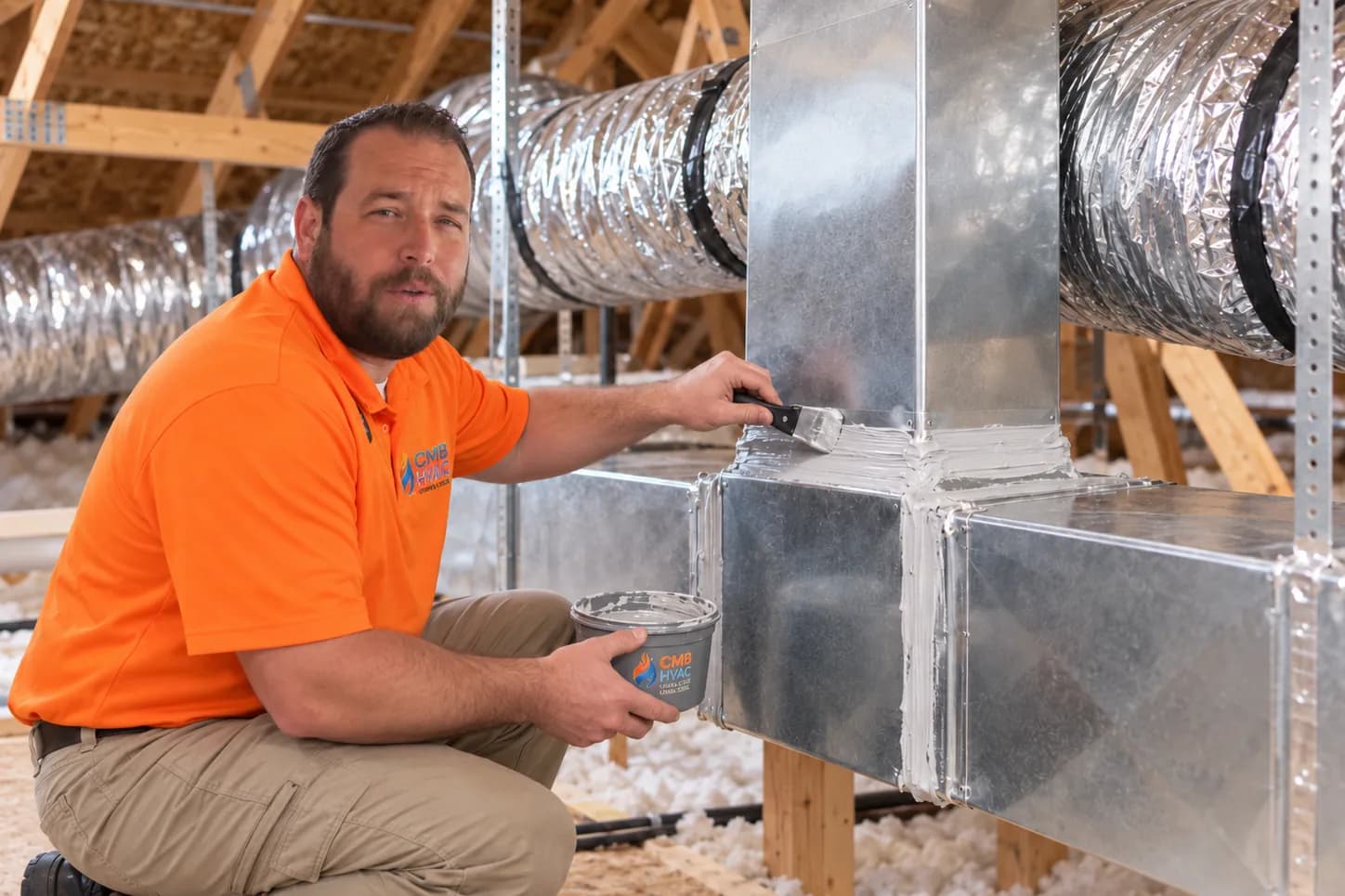
    Mechanical fastening, mastic, and rated tapes at code-approved points — never the cloth 'duct tape' joke.

  • Access honestly bounded

    Accessible versus concealed runs named on the quote — the limits of what sealing can reach, in writing.

  • Before/after numbers

    Static pressure and airflow measured on both ends of the job — the improvement verified, not asserted.

When to Look at Repair & Sealing

Each sign is a specific defect describing itself — the anchors explain the fixes.

What Duct Repair & Sealing Includes

  • Full accessible-run inspection with defects photographed
  • Static pressure measured before work — the baseline
  • Disconnected runs re-connected and mechanically fastened
  • Accessible joints, seams, boots, and penetrations sealed with mastic or rated materials
  • Crushed or torn flex replaced with properly supported runs
  • Insulation repaired or upgraded where condition calls for it
  • Before/after measurements documented and left with you

How We Survey a Duct System

  1. Measure first

    Static pressure and equipment airflow — the numbers that tell us how much story the ducts are hiding.

  2. Walk the accessible runs

    Attic, crawlspace, and mechanical spaces — every joint, boot, and transition examined and photographed.

  3. Grade the insulation

    Condition, jacket integrity, and evidence of condensation — especially where ducts cross unconditioned space.

  4. Map what's reachable

    Accessible versus concealed runs mapped honestly — the boundary of what any sealing scope can promise.

  5. Scope & verify

    Targeted repair quoted against the findings; the result verified with after-measurements, not assurances.

Seal, Repair, or Replace Sections

Different defects call for different depths — the survey decides which you're in.

  • Seal accessible leakage

    Joints, seams, boots, and penetrations sealed with mastic and rated materials — the highest-value fix in most attics.

    Best for: leaky-but-sound duct systems

  • Repair damaged sections

    Disconnected runs re-fastened, crushed flex replaced, failed supports corrected — the defects that choke whole rooms.

    Best for: localized damage on otherwise decent ducts

  • Replace sections (or more)

    When runs are unsalvageable — deteriorated, wrong-sized, or unreachable for repair — section replacement with proper materials beats another patch.

    Best for: failed sections and fundamental sizing problems

What Drives Duct Repair Costs

Duct work prices by access and extent — the survey determines both before the quote is written.

  • Access

    An open attic is a different job than a crawlspace or a chase buried in finished walls — access is priced, not assumed.

  • Extent of defects

    A handful of failed joints and a system-wide disconnection are different scopes discovered by the same survey.

  • Materials involved

    Flex runs, sheet-metal trunks, and boots each repair differently; insulation upgrades carry their own material costs.

  • Verification depth

    Before/after measurement is included on every job — more extensive systems simply carry more measurement points.

Repair and sealing are quoted flat-rate from the survey, with accessible versus concealed work stated on the face of the quote. We don't promise a savings percentage — real results depend on your system, your leaks, and your usage, which is why we verify with before/after measurements and hand you the numbers instead of a slogan.

How a Repair Job Runs

  1. Survey & document

    Baseline measurements taken, defects photographed, access limits mapped — before anything is quoted.

  2. Quote in writing

    Flat-rate scope with accessible vs. concealed stated plainly. No deposit until you decide.

  3. Repair & seal

    Runs re-fastened, joints sealed with lasting materials, insulation restored — home protected throughout.

  4. Verify & report

    After-measurements against the baseline, defects-file updated, maintenance notes left with you.

Attic Ducts in a Hard Climate

Wasatch Front homes overwhelmingly run ducts through unconditioned attics and crawlspaces — the hardest possible place for a duct system to live. Attics hit 130°F+ in July and below freezing in January, so every leak conditions the outdoors and every insulation gap sweats in summer. The local pattern is predictable: homes built in the big growth decades with flex-heavy systems and minimal sealing show the classic end-of-run starvation by year fifteen. The good news is that attic access makes those systems among the most repairable — and the before/after numbers are often dramatic.

  • Attic duct runs are worth inspecting every few years — shifting and heat cycle fatigue never stop
  • Rodents love flex duct in quiet attics; torn runs are a common local find
  • Sealing before summer is ideal: cooling losses through attic leaks are the most expensive kind

The Duct Vocabulary

The terms from your quote, explained — and the anchors for the signs above.

Sealing: Materials & Limits

Real sealing means mechanically secure joints closed with materials built for the service — mastic compound, mastic tape, or rated foil tapes at code-permitted points, on joints that are physically fastened. Cloth 'duct tape' fails on ducts within a couple of seasons; we don't use it. What sealing can't do: fix crushed duct, undersized runs, or sections buried under blown insulation and finished surfaces. The survey maps what's reachable — sealing the accessible 80% of a system is a real improvement with a real boundary, and the quote states both.

Insulation & Condensation

Duct insulation does two jobs: keeping conditioned air at temperature through unconditioned space, and keeping the duct's cold surface away from attic air that holds moisture. Failed or missing insulation shows up both ways — rooms losing their cooling on the way past the attic, and dark stains or sweating jackets where humid air meets cold metal. Repairs restore the full jacket, seal the vapor barrier, and mind the condensation risk points: above bathrooms, over long runs, anywhere cold metal meets summer air.

When Repair Isn't Enough

Some defects don't deserve another patch: flex crushed flat and left that way for years, runs torn along their length, metal deteriorated past sealing, or sections sized for a floor plan the house left behind. Replacement of the failed sections — with correct sizing, supported runs, sealed joints, and proper insulation — beats serial repairs on the same failing run. When the survey finds the problems are systemic rather than local, that's the honest moment to talk about partial or full replacement, and the conversation comes with both scopes priced.

Before the Attic Visit

How are duct leaks found?
Two ways, used together. The physical survey: walking every accessible run in the attic, crawlspace, and mechanical spaces, examining each joint, boot, and transition — with defects photographed. And the measurements: static pressure and airflow readings that tell us how much the system is struggling even where eyes can't reach. Some homes add pressure-matching readings at registers to localize hidden losses. What we deliberately don't sell: a vague 'leak detection' service with a camera and a pitch — the survey and the numbers find leaks, and they're included in the evaluation.
Is duct tape used to seal ducts?
Not the cloth stuff, no — which is the joke's whole point: cloth duct tape fails on ducts, drying out and peeling within a couple of seasons of attic heat. Professional sealing uses mastic compound (a paste applied to joints that cures into a permanent seal), mastic-backed tapes, and UL-rated foil tapes at the points code allows them — always over mechanically fastened joints. The materials cost more than a tape gun; that's why they still work in ten years, and why the before/after measurements hold.
Can damaged flex duct be repaired?
Often, with honest limits. Flex that's been disconnected from its boot or crushed once can be re-supported, re-connected, and re-sealed — a straightforward repair with immediate results. Flex that's been crushed flat for years, torn along its length, or chewed by rodents usually doesn't recover: the inner liner is what matters, and once it's compromised the run strangles airflow no matter how neat the outside looks. We replace failed sections with properly sized, supported runs — and the quote tells you which category each run fell into.
When should duct insulation be replaced?
When the jacket has failed: insulation that's fallen or compressed, a vapor barrier torn open, evidence of condensation staining, or insulation so thin the ducts are effectively bare in unconditioned space. In our climate the trigger points are attic runs above living space — the hottest, coldest, and most condensation-prone path in the house. Repairs restore the full jacket with sealed seams, which matters as much as thickness: an unsealed jacket lets attic air reach the duct surface, which is where the condensation story starts.
How much efficiency can leaky ducts cost?
Meaningful amounts — but we won't quote you a percentage, because honest numbers depend on your specific leaks, system, and usage, and the industry's generic figures describe systems we've never measured. What we do instead: baseline measurements before the work, the same measurements after, and the real numbers left with you. On typical local homes with attic duct systems and years of unsealed joints, the before/after difference is usually visible in both airflow at the far rooms and how long the system runs to hold temperature.

Stop Conditioning the Attic

Book online or call. Defects documented, scope quoted flat-rate, results verified with before/after numbers.