
Skip to content

Davis & Salt Lake County

CMB HVAC — Utah's Local HVAC

Home Ventilation

Fresh-Air and Ventilation Solutions Designed for the Home

Ventilation should bring in or exhaust the right amount of air without creating comfort, moisture, combustion, or pressure problems. CMB HVAC evaluates the building and HVAC system before recommending the ventilation products it actually supports.

Wide view of a CMB HVAC installation in progress
5.0 ★
369 Google Reviews
Licensed
UT 12883822-5501
Free
Service Call
Upfront
Fixed Pricing

Fresh-Air and Ventilation Solutions Designed for the Home

Modern homes are built tight, and tight homes hold their air — along with its moisture, odors, and whatever the occupants add to it. Ventilation is the discipline of exchanging that air deliberately: exhausting what you don't want, bringing in what the house needs, and doing both without wrecking the pressure balance, the humidity, or the combustion safety of the appliances inside.

That's why the evaluation comes first. Exhaust fans fight a tight envelope; supply air fights a leaky one; and the wrong approach in the wrong house creates the problems it was bought to solve. We install the approaches we can measure and commission — and where a project needs a dedicated ventilation designer (whole-house balanced systems, make-up air for heavy exhaust), we say so on the visit and refer honestly rather than improvise.

Ventilation Done Deliberately

  • Pressure-aware design

    The house's tightness and the HVAC's balance evaluated before any fan is specified — the step that prevents backdrafts.

  • Installed and balanced

    Airflow measured, controls set, commissioning documented — ventilation that's tuned, not just terminated.

  • Combustion safety checked

    Fuel-burning appliances considered in every design — ventilation must never starve a furnace or water heater.

  • Scope boundaries named

    What we install, measure, and commission — and what belongs with a dedicated ventilation designer.

When Ventilation Is Worth a Look

Each symptom describes a different exchange problem — the anchors explain the approaches.

What Ventilation Work Includes

  • Building and HVAC evaluation: tightness, pressure behavior, and existing exhaust
  • Combustion appliance review — the safety boundary every design respects
  • Approach recommendation: spot exhaust, supply fresh air, or balanced strategy
  • Equipment installed with proper termination, sealing, and controls
  • Airflow measured and balanced to the design
  • Controls set up and explained — timers, interlocks, seasonal adjustments
  • Commissioning report in writing, with the numbers

How We Evaluate a Home for Ventilation

  1. Read the house

    How tight, how it pressurizes, what exhaust already exists — the building's current exchange story.

  2. Check combustion safety

    Fuel-burning appliances inventoried and their venting reviewed — a boundary no ventilation design crosses.

  3. Find the exchange gap

    Where air should be moving and isn't: baths, kitchen, the stale rooms, the damp ones.

  4. Match the approach

    Exhaust, supply, or balanced — chosen against the house's actual leakage and the system's capacity.

  5. Design & boundary

    Quantity, filtration, and controls specified — with any specialist-scope honestly referred.

Exhaust, Supply, or Balanced

Three ways to exchange air — each right for a different house.

  • Spot exhaust, improved

    Bath and kitchen exhaust done right — correct termination, real airflow, controls that run it. The cheapest exchange a house can get, and the most commonly broken.

    Best for: homes whose baseline exhaust never actually worked

  • Supply fresh air

    Controlled outdoor air drawn into the return side, filtered on the way through the HVAC — pressure-friendly for tight homes and easy to integrate.

    Best for: tight homes with a functional exhaust baseline

  • Balanced strategy

    Exhaust and supply working together so the house neither pressurizes nor depressurizes — the approach for serious moisture and air-quality goals.

    Best for: homes with whole-house moisture or air-quality targets

What Drives Ventilation Costs

Moving air is cheap; moving it through a finished house to the right places is where scope lives.

  • Duct pathways

    Fresh-air and exhaust ducts need routes — an accessible path is a different job than one through finished ceilings.

  • Approach & equipment

    A corrected bath fan, a supply integration, or a balanced design are different scopes with different hardware.

  • Controls

    Timers, humidistat interlocks, and HVAC integration each add setup — and each changes how the system behaves daily.

  • Commissioning depth

    Measuring and balancing is part of the job we won't skip; complex designs simply carry more of it.

Ventilation work is quoted flat-rate after the evaluation, with commissioning included — airflow and control settings documented in writing. Where a project exceeds what we install and commission (dedicated whole-house balanced-system design, make-up air for heavy commercial-grade exhaust), the quote says so and names the referral instead of stretching our lane.

How a Ventilation Project Runs

  1. Evaluate

    Tightness, pressure behavior, existing exhaust, and combustion appliances — the design's foundation.

  2. Design & quote

    Approach, equipment, pathways, and controls specified — flat-rate, with boundaries named.

  3. Install

    Terminations, ducts, and equipment set with sealing and support; controls wired and configured.

  4. Balance & document

    Airflow measured to design, controls tuned, commissioning report in hand before we leave.

Inversion Season Changes the Math

Utah's winter inversions give ventilation an unusual local wrinkle: the days when a house most needs fresh air are exactly the days the outdoor air is at its worst. That's an argument for controlled exchange over open windows — filtered, measured, and timed — and for humidity-aware controls that slow the exchange when it's doing more harm than good. Add dry air on the other end (the same cold that traps pollution also desiccates), and the local ventilation question is really a balancing act: exchange enough to exhaust moisture and odors, not so much that the house can't hold comfort or humidity.

  • Winter is when ventilation gaps show: fogged windows, lingering odors, condensation at sills
  • Bath fans that dump into the attic are an attic-mold project waiting to happen — worth checking
  • Fireplace and wood-stove evenings are a combustion-safety reason to know your home's pressure behavior

The Ventilation Vocabulary

The terms from your quote, explained — and the anchors for the signals above.

Exhaust, Supply & Balanced — Including HRVs and ERVs

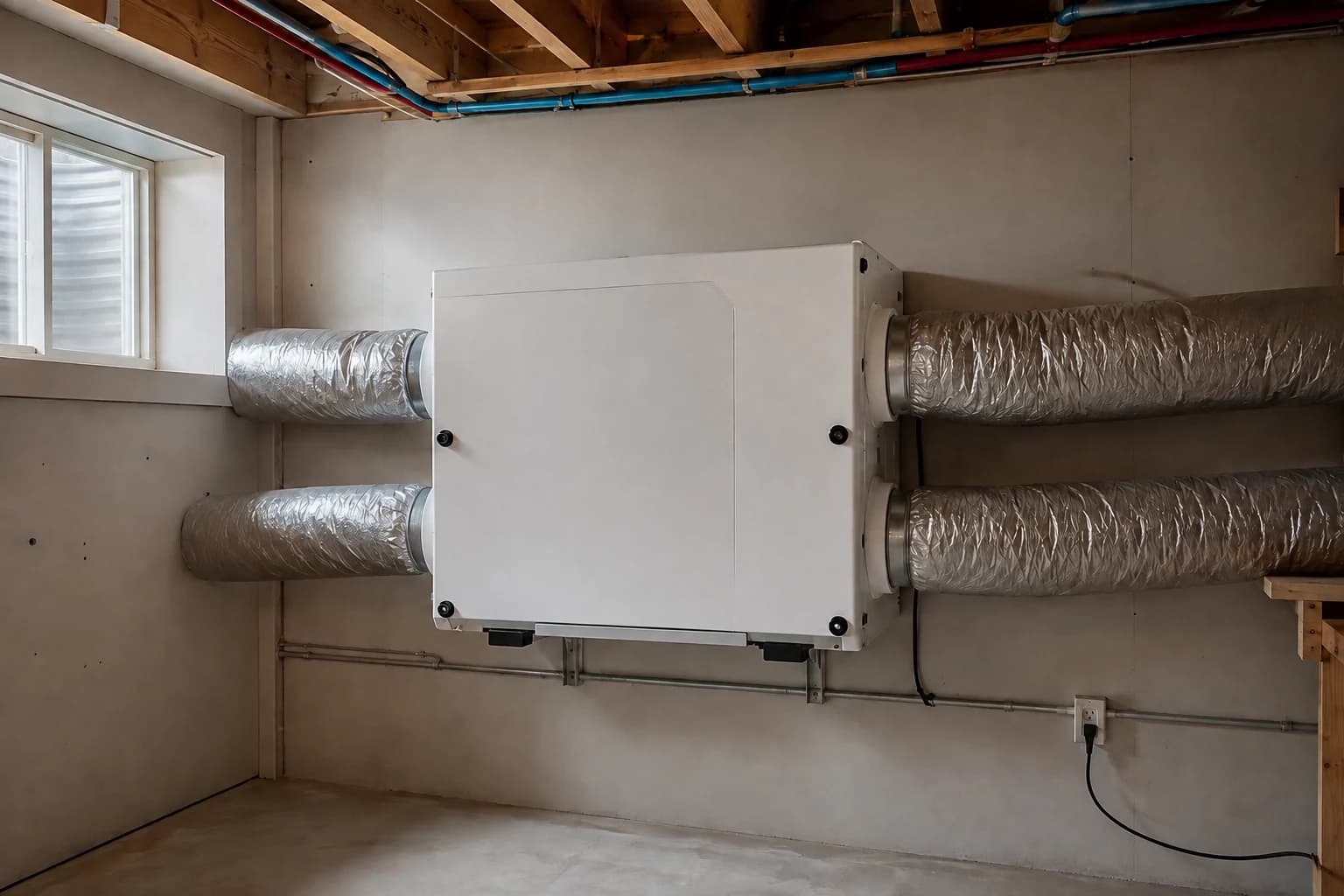
Spot exhaust pulls air out (baths, kitchen); supply pushes filtered outdoor air in through the HVAC; balanced does both at matched rates. Heat-recovery ventilators (HRVs) and energy-recovery ventilators (ERVs) are the balanced approach's flagship equipment — they exchange stale and fresh air through a core that recovers most of the temperature (and, for ERVs, humidity) on the way past. These are real disciplines to design and commission correctly: quantities, pressure, filtration, condensate, and controls. We assess on the visit whether a home's project fits what we install and commission, and refer dedicated recovery-ventilator and make-up-air designs to ventilation specialists when it doesn't.

Integration, Pressure & Make-Up Air

Every fan in a tight house is a pressure decision: exhaust without replacement depressurizes, and a depressurized house can backdraft combustion appliances — the one outcome a ventilation design must never cause. Supply approaches integrate with the return duct so outdoor air arrives filtered and conditioned; heavier exhaust loads need deliberate make-up air to keep the house neutral. We review combustion venting as part of every evaluation, because the safety boundary isn't adjacent to the design — it is the design.

Balancing & Commissioning

A ventilation system isn't done when it's wired — it's done when it's measured. Airflow at each termination checked against design, controls set for the household's actual rhythm, seasonal behavior explained, and the numbers recorded in a commissioning report. The alternative is the familiar one: a fan that hums in a closet while the house stays stale. Measurement is the difference between installed and working, and it's the part of the job we treat as non-negotiable.

Fresh-Air Questions, Answered

What is the difference between an HRV and ERV?
Both are balanced-ventilation devices that exchange stale indoor and fresh outdoor air through a core that transfers energy between the streams. An HRV (heat-recovery ventilator) recovers temperature only — the right fit where winter humidity is already high enough. An ERV (energy-recovery ventilator) also transfers moisture, tempering the dryness that outdoor winter air would otherwise import — which, in Utah's climate, is why ERVs often fit our winters better. Both are designed disciplines: sizing, pressure, condensate, and commissioning. When a home's project calls for one, that's assessed at the visit — and referred to a dedicated ventilation designer when it's outside our install scope.
Can ventilation help with stale air or odors?
Yes — that's literally its job. Lingering odors are the textbook symptom of a house that isn't exchanging air: the same cooking, pet, and living smells recirculating through one closed volume. Deliberate ventilation replaces that volume on a schedule instead of by accident. The honest caveat: ventilation dilutes, it doesn't eliminate a source. A smell with an address — a damp crawlspace, a failed wax ring, an unvented appliance — needs the source fixed, and the ventilation keeps the house fresh afterward.
Will outside air increase heating and cooling costs?
Some, because conditioning exchanged air is real energy — but far less than the marketing on both sides suggests. Controlled ventilation runs in measured quantities on schedules, not open windows all day; recovery-type equipment can reclaim most of the temperature difference on the way through; and the accounting cuts both ways, since moisture carried out in summer or managed in winter changes how hard the equipment works. The honest framing: ventilation is a small operating cost attached to a large comfort and air-quality gain, and the controls decide how big the small cost is.
Does my home need make-up air?
The test is pressure behavior, and the appliances decide how much it matters. If running the bath fans and range hood depressurizes the house enough to fight a furnace or water-heater draft, make-up air isn't optional — backdrafting combustion is the one ventilation failure that's dangerous rather than just uncomfortable. Signs worth taking seriously: fans that whistle, doors that drift shut, a fireplace that smokes when the kitchen exhaust runs. Our evaluation measures the behavior and reviews combustion venting before any design, which is the order that keeps the answer safe.
How is a ventilation system balanced?
With instruments, room by room — not by feel. Each supply and exhaust point is measured against the design quantity, adjusted, and re-measured until the totals match and the house stays neutral under operation; controls are then set for the household's real schedule and the results recorded in the commissioning report. That measurement is the difference between a system that works and a system that's installed — and it's why 'balanced' is a documented outcome on our jobs, not a brochure word.

Give the House an Air Exchange That Works

Book online or call. Evaluated against pressure, moisture, and combustion safety — then installed, balanced, and documented.