
Skip to content

Davis & Salt Lake County

CMB HVAC — Utah's Local HVAC

Tankless Installation & Replacement

Tankless Water Heaters Sized by Flow and Temperature Rise

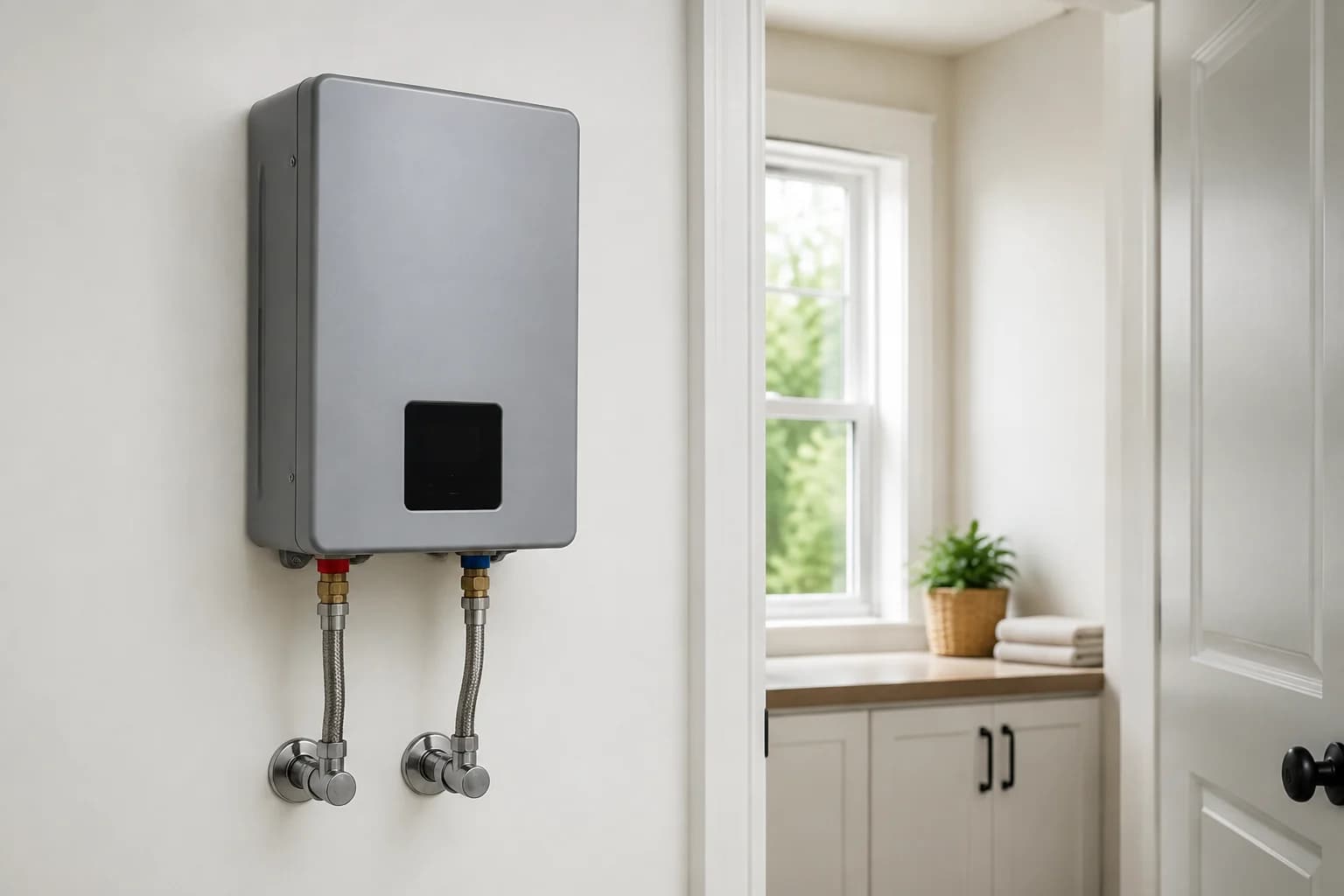
Tankless systems can provide continuous hot water within their rated capacity, but they are not unlimited under every simultaneous demand. CMB HVAC evaluates required flow, incoming-water temperature, fuel/electrical capacity, venting, condensate, plumbing, water quality, and service access.

Plumber installing new shutoff valves and supply lines
5.0 ★
369 Google Reviews
Licensed
UT 12883822-5501
Free
Service Call
Upfront
Fixed Pricing

Tankless Water Heaters Sized by Flow and Temperature Rise

Tankless units heat water as it flows, which is why they never run a tank empty — and also why their honest spec is a flow rate at a temperature rise, not an 'endless' promise. Run the shower, the dishwasher, and the laundry simultaneously in a Utah January (groundwater cold enough to demand a big rise) and an undersized unit delivers cooler water to all three. Sizing right means counting your real simultaneous fixtures and measuring what the incoming water asks of the unit.

The other half of tankless honesty is what the installation asks: gas lines frequently need upsizing, venting is usually dedicated and Category III/IV specific, condensate needs a drain, hard water demands a descaling schedule, and the unit wants service clearance. We evaluate all of it before the quote — because a tankless install is a system project, and the quote should show the whole system.

What a Real Tankless Evaluation Includes

  • Flow and rise calculated

    Simultaneous fixtures counted, incoming water temperature measured — the two numbers that size the unit.

  • Utilities verified

    Gas line capacity, electrical, venting route, condensate drain — checked before the quote, priced on it.

  • Water quality addressed

    Hard-water treatment discussed and a descaling plan in writing — the maintenance tankless can't skip.

  • Commissioned at startup

    Flow, temperature rise, and combustion set up and recorded — performance verified, not promised.

When Tankless Deserves a Look

Each situation is a different fit — the anchors explain the details.

What the Quote Covers

  • Flow-and-rise sizing calculation against your actual fixtures
  • Gas line (or electrical) capacity evaluation and upsizing scope if needed
  • Dedicated venting route, combustion air, and termination planned
  • Condensate management: neutralizer and drain provisions
  • Water-quality evaluation with treatment and descaling plan in writing
  • Service clearances and mounting location verified
  • Old unit removal, permit handling, and disposal
  • Startup commissioning: flow, rise, combustion, and temperature set with you

How We Evaluate a Home for Tankless

  1. Count the simultaneous demand

    Which fixtures actually run together — the honest flow number that sizes the unit, not the brochure's fantasy morning.

  2. Measure the incoming water

    Cold groundwater means a bigger temperature rise — the number that turns a modest unit into an undersized one.

  3. Check the fuel

    Gas line sizing and meter capacity verified — the most common hidden cost in tankless conversions.

  4. Plan the routes

    Venting, condensate, and service clearance laid out — where the unit can live and what getting there costs.

  5. Read the water

    Hardness assessed; treatment and the descaling schedule attached to the quote — maintenance planned, not discovered.

Whole-Home, Point-of-Use, or Hybrid

Tankless isn't one product — the right shape depends on the house.

  • Whole-home gas unit

    One high-output unit serving the house — the classic tankless install, with gas capacity, dedicated venting, and a descaling plan as part of the package.

    Best for: homes with serious simultaneous demand and gas service

  • Point-of-use electric

    Small units at specific fixtures — a far bathroom, an addition — delivering hot water without long pipe runs.

    Best for: targeted fixes, not whole-house conversion

  • Staying with a tank (honestly)

    Some homes' demand, utilities, and water quality add up to 'a right-sized tank is the better tool' — and the evaluation is allowed to conclude exactly that.

    Best for: houses the tankless math doesn't favor

What Drives Tankless Cost

The unit is the visible line; the utilities and water quality around it are the real project.

  • Capacity class

    Higher flow rates and colder-water rises demand bigger units — sized from the calculation, not the price ladder.

  • Gas and electrical work

    Upsized gas lines, new circuits, and meter capacity are the most common conversion costs — verified before the quote.

  • Venting & condensate

    Dedicated venting runs, terminations, neutralizers, and drain access — each planned, each priced openly.

  • Water treatment

    Scale protection and the descaling plan are part of owning tankless here — included in the quote, not sold later.

Tankless projects are quoted flat-rate with every line itemized — unit, gas, venting, condensate, treatment, permit, and labor. We compare tank-versus-tankless total cost honestly, with the assumptions (demand, fuel, maintenance) stated, and no guaranteed-savings promises anywhere in the quote.

How a Tankless Project Runs

  1. Evaluate

    Flow and rise calculated, gas and venting verified, water quality read — the fit determined before the quote.

  2. Quote in writing

    The whole system scope flat-rate — including what the conversion honestly costs versus a tank replacement.

  3. Install

    Gas, venting, condensate, and piping built to spec; unit mounted with service clearance; permit handled.

  4. Commission & schedule

    Flow, rise, and combustion recorded; temperature set with you; the descaling calendar put in writing.

Cold Water, Hard Water — Both Real

Utah stresses tankless equipment from both directions. Cold groundwater in winter inflates the temperature-rise requirement — a unit that fills a summer shower generously delivers cooler water on a January morning — and the region's hard water scales heat exchangers faster than most manuals assume. Both are planning problems, not dealbreakers: size to winter rise, not summer comfort, and treat the descaling schedule as part of owning the equipment. Homes that do both are the ones whose tankless units actually deliver the experience the brochure promised.

  • Size to winter: the coldest incoming water is the honest design condition
  • Descaling is not optional here — skip it and the warranty's fine print becomes the story
  • Navien units are among the brands on our public listing — the evaluation matches the model to the house

The On-Demand Vocabulary

The terms from your quote, explained — and the anchors for the questions above.

Flow Rate & Temperature Rise

Every tankless unit has a curve: the hotter the temperature rise it must produce, the lower the flow it can carry. Rise is the difference between incoming groundwater and your setpoint — and Utah winters make that gap wide. Add up the fixtures that genuinely run at once (shower 2ish GPM, dishwasher another, laundry another) and the two numbers meet at an honest capacity. That's the whole sizing discipline: 'endless hot water' means continuous, not infinite — within the unit's rated capacity, always.

Gas, Venting, Condensate & Clearances

High-output gas units draw hard: the gas line often needs upsizing from what a tank ran on, and the meter capacity gets verified too. Venting is typically dedicated, sealed, category-specific — not a shared chimney — with its own termination rules. Condensing units make condensate that wants a neutralizer and a drain. And the unit needs service clearance on its front face, because the descaling pump has to connect somewhere. Each of these is checked at the evaluation; each is a line on the quote.

Hard Water & the Descaling Plan

Scale on a tankless heat exchanger does exactly what scale does in a kettle: strangles heat transfer and flow until the unit can't keep up. Utah's hard water makes this an operating requirement, not a suggestion — treatment (softening or conditioning) discussed at the evaluation, and a manufacturer-specific descaling procedure on a written schedule. Skip it and the symptoms arrive as falling flow and temperature swings a few winters in. Include it and the unit delivers for its full, genuinely long service life.

Replacing an Existing Tankless Unit

A tankless replacement is a recalculation, not a box swap: the household's demand may have changed, the old unit's scale history tells you about the water treatment (or its absence), and gas, venting, and condensate get re-verified against the new model's requirements. The scope includes cleaning the piping it inherits, commissioning the startup measurements, registering the warranty, and handing you a fresh descaling plan. Done that way, the new unit starts its clock honestly.

Straight Answers Before You Convert

Will a tankless heater give me endless hot water?
Continuous — within the unit's rated capacity, which is the honest version of that promise. A correctly sized unit never runs out the way a tank does, because it heats as it flows. What it can't do is exceed its flow-at-a-temperature-rise curve: every fixture drawing at once in January asks for more capacity than physics lets a given unit deliver. That's why the sizing calculation comes first — count the real simultaneous fixtures, measure the incoming water, and pick the unit whose curve covers your actual worst morning.
How many fixtures can run at once?
As many as the unit's rated flow covers at your winter temperature rise — which is exactly the calculation we do. In practice: a properly sized whole-home unit handles two showers, or a shower plus dishwasher plus sink, in most seasons; January's near-freezing incoming water narrows that, and an undersized unit compensates by delivering cooler water rather than none. The honest answer for your house comes from counting your fixtures and measuring your water — not from a brochure's 'up to' number.
Will I need a larger gas line?
Often, yes — it's the most common conversion cost we find. Tankless units fire at high output in short bursts, which demands more gas volume than the line a tank ran on comfortably provided; undersized gas lines are the classic cause of a new tankless unit locking out or underperforming. The evaluation measures the run, checks the meter capacity, and prices any upsizing as its own line on the quote — discovered before install day, not during it.
Does tankless need annual descaling?
In this region, a regular descaling schedule is part of owning the equipment — the exact interval comes from the manufacturer's guidance adjusted for your water hardness, and Utah's water argues for the diligent end of every range. It's a straightforward service: a pump, food-grade descaler, and the unit's service valves, run through the heat exchanger and flushed. Membership can carry it on schedule, or we'll show you the procedure at startup. Skip it here and scale will find the exchanger — the only question is which winter.
Can it use my existing vent?
Usually not — and that's worth knowing before the quote, not during the install. Tankless units typically require dedicated, sealed, category-specific venting with their own termination rules; the chimney or B-vent route a storage tank used doesn't transfer. Converting an existing tank location also means planning the new vent's route through the house and the condensate drain it adds. All of it is verified and priced at the evaluation — the venting scope is one of the lines that makes a tankless quote honest.
How long is the warranty?
Tankless warranties run long — typically a decade or more on the heat exchanger from the manufacturers we install — but the fine print has teeth: registration, professional installation, and the maintenance schedule (descaling included) are usually conditions of coverage. We register the warranty at startup and put the maintenance plan in writing, which is how the long warranty stays real instead of theoretical. The written quote spells out what's covered by whom before you sign anything.

Get the Tankless Math Before the Purchase

Book online or call. Flow and rise calculated, gas and venting verified — and an honest tank-versus-tankless comparison in writing.